The Android Essentials:
How you master the most demanded
Android skills in 2026’s job market.
Learn the fundamental Android concepts from Philipp Lackner to triple your technical confidence, nail your interviews and earn what you’re truly worth
– 13 years of coding experience broken down into 17h of digestible video lessons –

You want to…
- … get a clear structure to learn everything that matters in the industry?
- … feel 100% confident about the code you write?
- … learn the essential skill set to stand out in the current market again?
- … get back on track and learn Android’s most modern technologies?
- … stop wasting time on learning what you end up not needing at all?
Why most people will never truly make it as developers.
On the surface, app development is simple. Everything you need seems to be available online for free. However, if we’re honest, this is not as much of a blessing as it sounds like.
It leads to most developers losing themselves in details that absolutely don’t matter for the industry. Meanwhile, they completely oversee that it all starts with the essentials. It starts with the architectural and technical foundation every software needs. You can’t learn these essentials by reading a few docs. These can be only learnt by implementing them in real apps. If you don’t master these essentials in the first place, you completely lack the foundation for anything you’ll face in the industry.
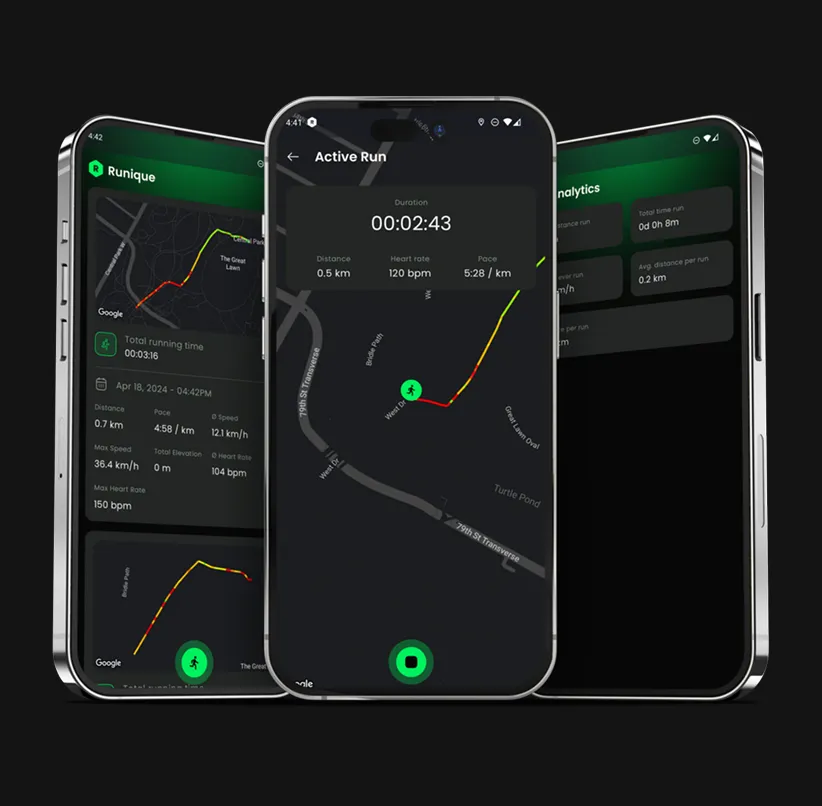
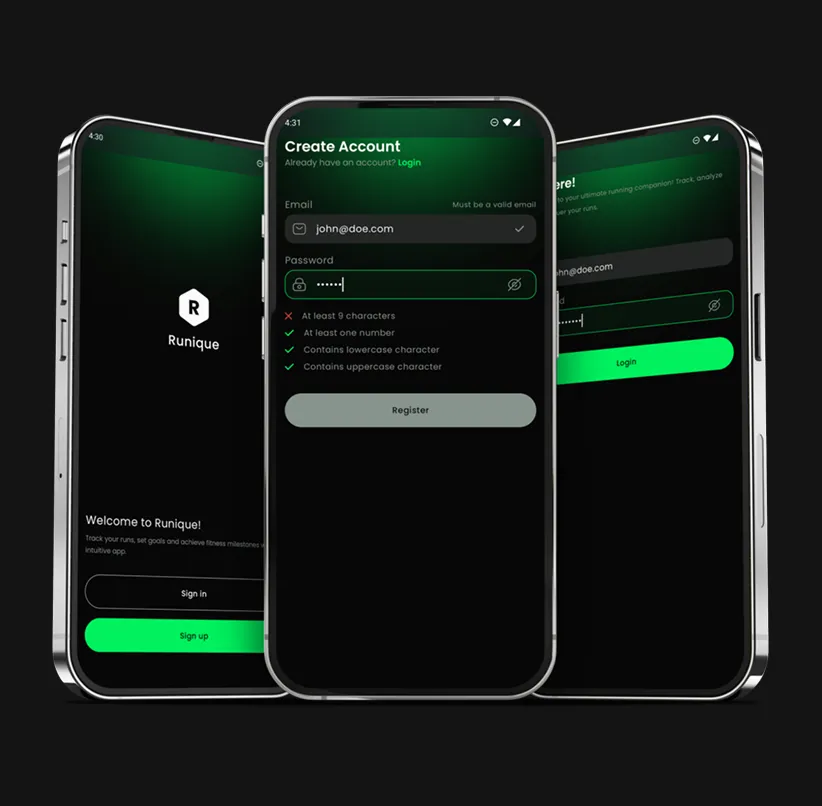
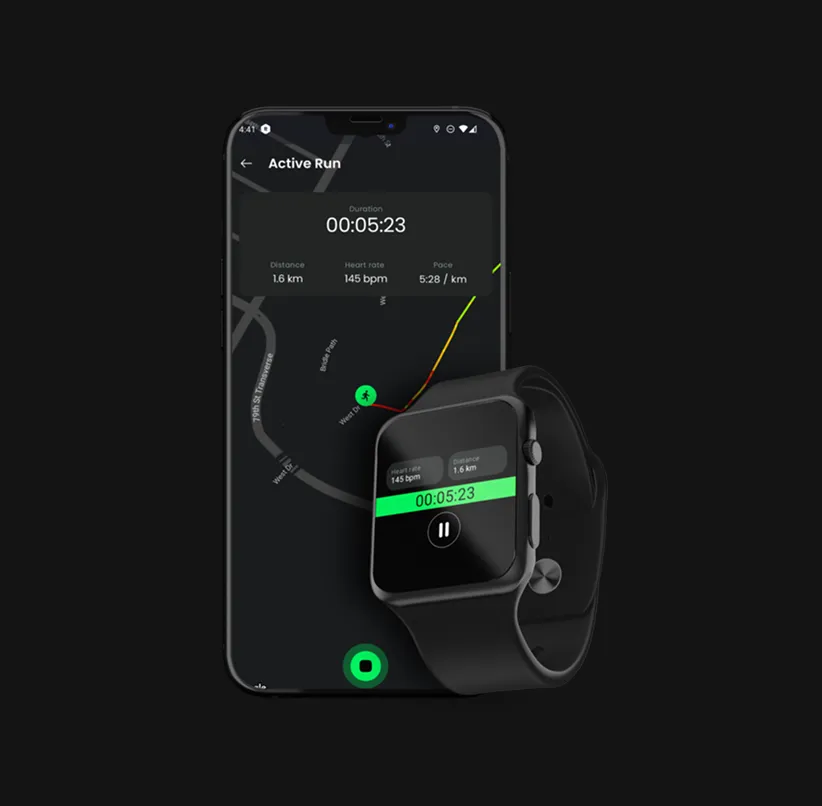
This is runique – the app you will build in this course
1. Build an Industry-Level Running Tracker App
- Learn to track runs in real time, and track meaningful health data from your users
- Sync runs with the cloud by connecting the app to a remote backend
- Learn to work with the Google Maps SDK to track and display the user’s location in real time

2. Implement a Complete authentication system
- Get exclusive access for a remote API to let users create accounts and log in
- You will learn the ins and outs of OAuth and implement proper session management
- You’ll learn all the relevant architectural practices that help you to implement such features into a scalable project

3. Connect to a smart watch
- You will learn to build a Wear OS app in order to track more vital health data such as the user’s heart rate
- Learn to discover paired devices, and connect to the right one
- Implement watch to phone communication and what it takes to correctly sync exercise data
- Get to know the health services API to implement proper exercise tracking

While you should focus on …
- … proper planning and structuring apps so that they scale and are easy to be worked on in a team
- … the essential technologies that EVERY app is built on top of
- … the fundamental architectural principles without becoming religious about a specific paradigm (e.g. Clean Architecture)
- … truly understanding these essentials in-depth, since the rest will come by itself

Most devs think they should focus on …
- … what is the best library for implemented a specific feature in their app.
- … blindly learning every new technology in the moment it reaches the alpha state
- … learning the typical “best practices” having no clue why and if they’re actually helpful
- … strictly sticking to specific architectural rules, like clean architecutre (without even understanding why)

Philipp Lackner has over 14 years of experience in the software field. Over the past years, he built a following of over 250,000 developers on social media who trust his work. With over 25,000 sold copies of his courses and 1,000h+ spent for teaching Android concepts, he already helped hundreds of thousands people to learn practical skills they can immediately apply.
He has a degree in computer science, however it didn’t go as expected. The amount of theory that was taught in university made him think about a better approach to learn what is really needed in the real world. Over time, Philipp found mentors who taught him exactly that in a practical setting. That was the game changer for his career.
After having worked for dozens of companies around the globe as a consultant, Philipp now wants to teach other Kotlin developers what really counts for becoming an outstanding developer in today’s competitive industry.
Of created Android content
Enrolled students
Years of software dev
What you will learn in this course
Project Planning
How do you even start a project without having a clear structure?This course will teach you how to come up with a starting structure that is set up to scale based on your app’s requirements.
Multi-Module Architecture
You will learn the ins and outs of a multi-modular Android codebase. Specifically, that means:
- The foundation of every good architecture
- Why and when to pick a multi-module architecture?
- Which modularization strategy is the best?
Gradle for Large Scale Projects
The more your project grows, the more managing its builds becomes a mess. In this course, you will learn proven strategies that allow you to tame Gradle and…
- … have light speed builds
- … manage your project config at a central place
- … implement proper dependency management
Synchronization
You will learn to implement a complete OAuth authentication system with proper to learn how user authentication works in the real world. This includes both registering new users and letting these log in safely.
Offline-First Development
Nothing is more underestimated than the complexity of offline-first apps. Doing this right depends on a…
- … well-structured local database cache
- … proper syncing strategy
- … working retry mechanism
Dynamic Feature Modules
You will learn to implement dynamic features that let your users install them on-demand after installing your app.This is crucial to minimize the final app size by not wasting storage for features only some users need.
Google Maps SDK
In this course, you will closely work with the Google Maps SDK to implement custom maps, draw tracks and consistently track the user’s location – even in the background.
Wear OS Development
Another 6h of video content will be completely dedicated towards building a smart watch app that connects to the main app built in this course.
These +100 Videos are waiting for you
Get Access to 17h of Exclusive Video Material
- What will we build?
- What if you run into errors during the course?
- How you get access to the backend
- Downloading the initial resources
-
- Separation of concerns (Presentation, domain & data layers)
- What is a module?
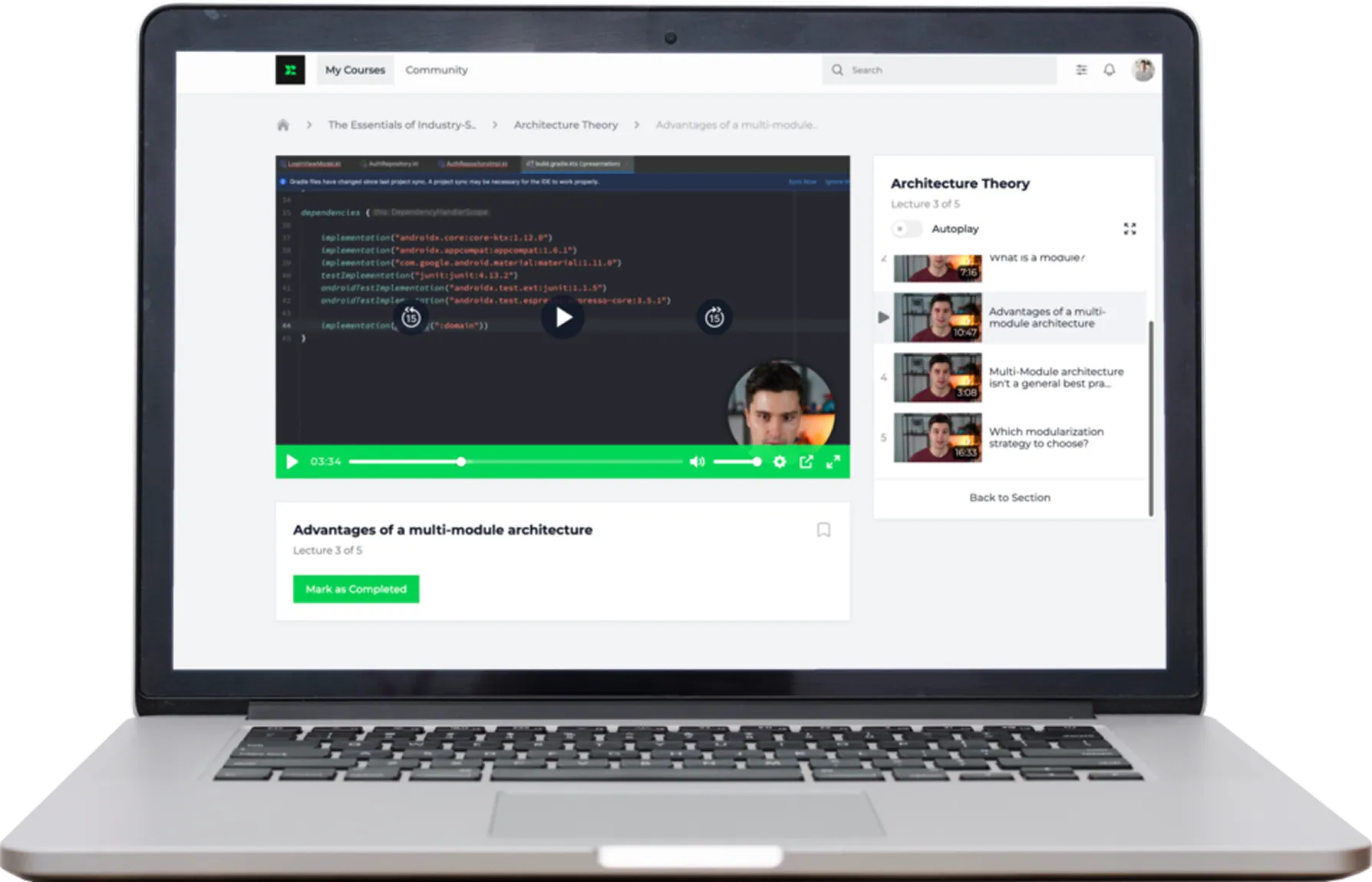
- Advantages of a multi-module architecture
- Multi-module architecture isn’t a general best practice
- Which modularization strategy to choose?
- Finding the sweet spot between modular design and low complexity
- Single-Responsibility PrincipleSeparation of concerns (Presentation, domain & data layers)
- Open-Closed Principle
- Liskov-Substitution Principle
- Interface-Segregation Principle
-
- Bird’s eye view
- Determine features and components
- A good architecture grows with the project
-
- What is the job of Gradle?
- Gradle challenges in a multi-module project
- Setting up the module structure
- Setting up the version catalog
- Defining the module relations
- Setting up the build-logic module
- AndroidApplicationConventionPlugin
- AndroidApplicationComposeConventionPlugin
- AndroidLibraryConventionPlugin
- AndroidLibraryComposeConventionPlugin
- AndroidFeatureUiConventionPlugin
- AndroidRoomConventionPlugin
- JvmLibraryConventionPlugin
- JvmKtorConventionPlugin
-
- Creating the error handling wrapper
- String resource management
- Observing one-time events in Compose
- Creating the Material theme
- Creating the MaHttpClient utilityterial theme
-
- Intro screen UI
- Register screen UI
- Validating user data
- Navigation graph & DI setup
- Registering usersSetting up session storage
- Setting up the token refresh mechanism
- Login screen UI
- Logging in users
- Splash screen & staying logged in
-
- Creating the run overview screen skeleton
- Creating the active run screen skeleton
- Setting up permission handling
- Implementing location tracking
- Testing location tracking on a real device
- Implementing the running timer logic
- Setting up the running tracker
- Setting up the ActiveRunViewModel
- Getting a Google Maps API key
- Displaying the Google map
- Drawing the running track on the map
- Showing the paused run dialog
- Fixing the polyline bug
- Tracking runs in the background
-
- Setting up the run models
- Implementing the run list item UI
-
- The challenges of offline-first apps
- Implementing the Room database
- Implementing the run API
- Finishing a run
- Saving, showing & deleting runs
- Saving pending syncs
- Creating the sync workers
- Scheduling syncs
- Implementing the logout mechanism
-
- What is a dynamic feature module?
- Creating the dynamic module structure
- Setting up the analytics dashboard screen UI
- Calculating run analyticsImplementing dynamic delivery
- Creating the sync workers
- Scheduling syncs
- Implementing the logout mechanism
-
- How does Wear OS compare to mobile apps?
- How watch to phone communication works on Wear OS
- Pairing mobile and Wear OS emulators
-
- Setting up the project structure
- Wear OS theme setup
- Implementing the tracker screen UI
- Tracking heart rate and exercise
- Setting up Wear OS permission handling
- Discovering paired devices
- Syncing data between watch and phone
- Sending and receiving messages on the watch
- Sending and receiving messages on the phon
- Keeping the watch app alive in the background
- Topic
-
This is runique – the app you will build in this course

1. The Essentials of Industry-Level Android App Development
- Learn the architectural foundation of ANY software out there, so you can plan and structure your own apps from the ground up
- Full guide to Gradle in large projects: No more frustration thanks to convention plugins, version catalogs and the right Gradle config
- Use the technical essentials in a real app: Learn token based authentication, databases, remote APIs, caching & syncing strategies, dynamic features and properly implementing SDKs into an existing architecture

2. Optional add-on: Building Industry-Level Wear OS Apps
- Learn the foundation of Wear OS apps:
- What is different about Wear OS and how does device-to-device communication work?
- Use the health services API and learn to track user’s workouts together with crucial health data such as the heart rate
- Learn to properly structure a codebase to reuse a maximum amount of code between two platforms
- Understand how always-on works on Wear to keep the display on while not draining the battery of the watch too much

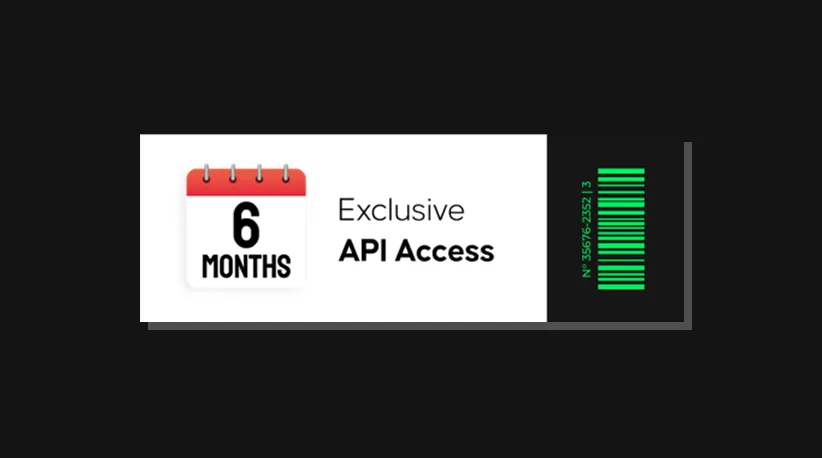
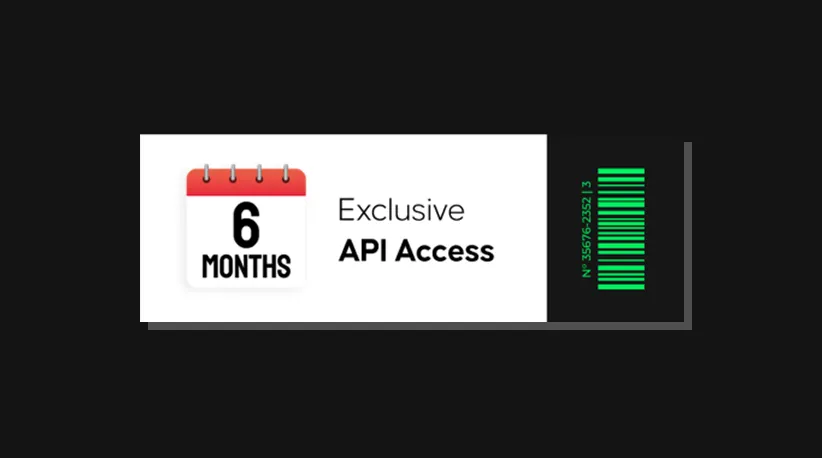
3. 6-Months of API Access
- Gain access to a ready-made backend that lets you log in and save a user’s tracked runs remotely
- Use this to correctly learn how data is properly synced and cached to allow a smooth offline-first experience
- After your access expires, you will still be able to use this API locally on your machine to follow through the courses
Resultss & case studies from our students
Martin Kiper convinced his interviewers thanks to Philipp’s courses.
- Felt lost in his own projects
- Didn't feel confident in Android interviews
- Confidently nailing coding interviews
- Feels confident about advanced topics like multi-module architecture
- Convinced employers of having a higher seniority than before
- Android developer in India
- No real hands-on experience on developing complex apps
- Low salary
- Got a well-paying job in Canada
- Understood the new company's tech stack the moment he joined
- Confidently develops real-world applications
- Wasn't able to build his own apps
- Felt insecure about architecture, Compose and more advanced topics
- Approaches projects for himself and clients confidently
- Truly understands the entire relevant Android tech stack
What people are saying
about Philipp’s courses
Real-world insights, structured learning, and expert mentorship that transform careers.
"This course brought me back on track really fast and Philipp really took care to convey general knowledge that can be applied on every Android project."
Matthias Kerat
"I have been using modularization for a long time, but I learned new cool stuff and tricks in your course that will change my way of thinking about how I should design my code."
Amer Hadi
"What’s unique about Philipp, that he cares about those who are looking for help, he answers to PM’s, I’ve never had experience like that."
Ozzy
"Your course let me also the opportunity to enhance my jetpack compose and unit test skills . So, I can consider me super satisfied. Please, don’t stop mentoring."
Vitanio Daniele
"Taking any of Philipp’s courses makes you go from 0 to almost 100 in understanding the concepts in no time. He explains the basics so well and teaches real world application use cases."
Messy Limes
"I’ve had struggles working with big projects, but after this course I feel so much more confident in my skills in building large robust apps."
Luka Luković
"I recently completed this course, and I couldn't be more thrilled with the experience! This course exceeded my expectations in every way. Philipp's real-world experience was evident. He covered everything from Ul design to integrating APls and managing databases,... Overall, this course was an incredible learning journey. I highly recommend it to anyone looking to start or advance their career in Android development!"
Erdem Kaya
"Philipp is an amazing developer who explains the most difficult topics in a way that's digestible and it stays with you. Everything is through practical examples. He's someone you'd want to go to, to understand something that you can't understand"
Omer Quadri
"This is one of the best courses for android development I have taken, not only we get to learn a lot but we also get an insight of where the industry is heading and how to approach problems and projects."
Jose Agustin Reinoso
This course is for you if…
- … you feel lost in the fast paced tech world and want to learn what really matters.
- … you need someone straight from practice who teaches you what really counts in the industry.
- … you know how to build basic Android apps, but always struggle to glue everything together to a well-structured and scaling app.
- … you lack the time to learn all the industry relevant strategies on your own.
- … you are sick of all those resources that only cover theory, but don’t show you how things work in a REAL app.

The full offer at a galance
Make a one-time investment and gain skills that last forever
The Essentials of Industry-Level Android App Development:
- Learn the fundamental architectural and technical concepts used in ANY Android app out there to remain relevant as a native Android developer in the fast-paced tech world.

Optional Add-On: Building Industry-Level Wear OS Apps:
- Learn to build powerful smart watch Android apps, connect them with your phone and track important health data.

BONUS: 6-Months of API Access:
- Right now, you get FREE access to a public API used in the course, so you can learn to properly implement syncing data with a remote backend.